Solutions

Prioritize Identity Risks That Actually Matter

Context-aware risk scoring across protocols, services, and identity objects. Stop chasing every misconfiguration—focus remediation on the exposures that create the biggest impact.

Core Features

  • Misconfiguration Detection
  • Context-Aware Prioritization
  • Vulnerability Lifecycle Management
  • Risk & Exposure Scoring

From Noise to Signal in Identity Risk

The Challenge

Identity environments generate thousands of findings — misconfigurations, excessive permissions, outdated protocols, risky delegations. Without context, security teams drown in noise. Real risks hide behind low-priority alerts, and remediation effort goes to findings that don't matter.

Our Solution

Forestall cuts through alert noise with context-aware risk scoring. Every finding is evaluated against exploitation certainty, required privilege level, and ease of mitigation — then mapped to MITRE ATT&CK for standardized severity. Teams get prioritized remediation queues with actionable guidance, not endless spreadsheets.

Fix Highest-Impact Risks First

Reduce Remediation Fatigue

Map to MITRE ATT&CK

Track Progress Over Time

Bridge Security and IT

Support Continuous Assessment

Core Capabilities

Comprehensive risk detection and prioritization that turns raw identity findings into actionable remediation plans.

Misconfiguration Detection

Identify critical misconfigurations across the full identity stack—protocols, objects, services, and security settings.

  • Detect critical misconfigurations across protocols, objects, services, and settings
  • Identify excessive, outdated, or misconfigured access privileges across objects
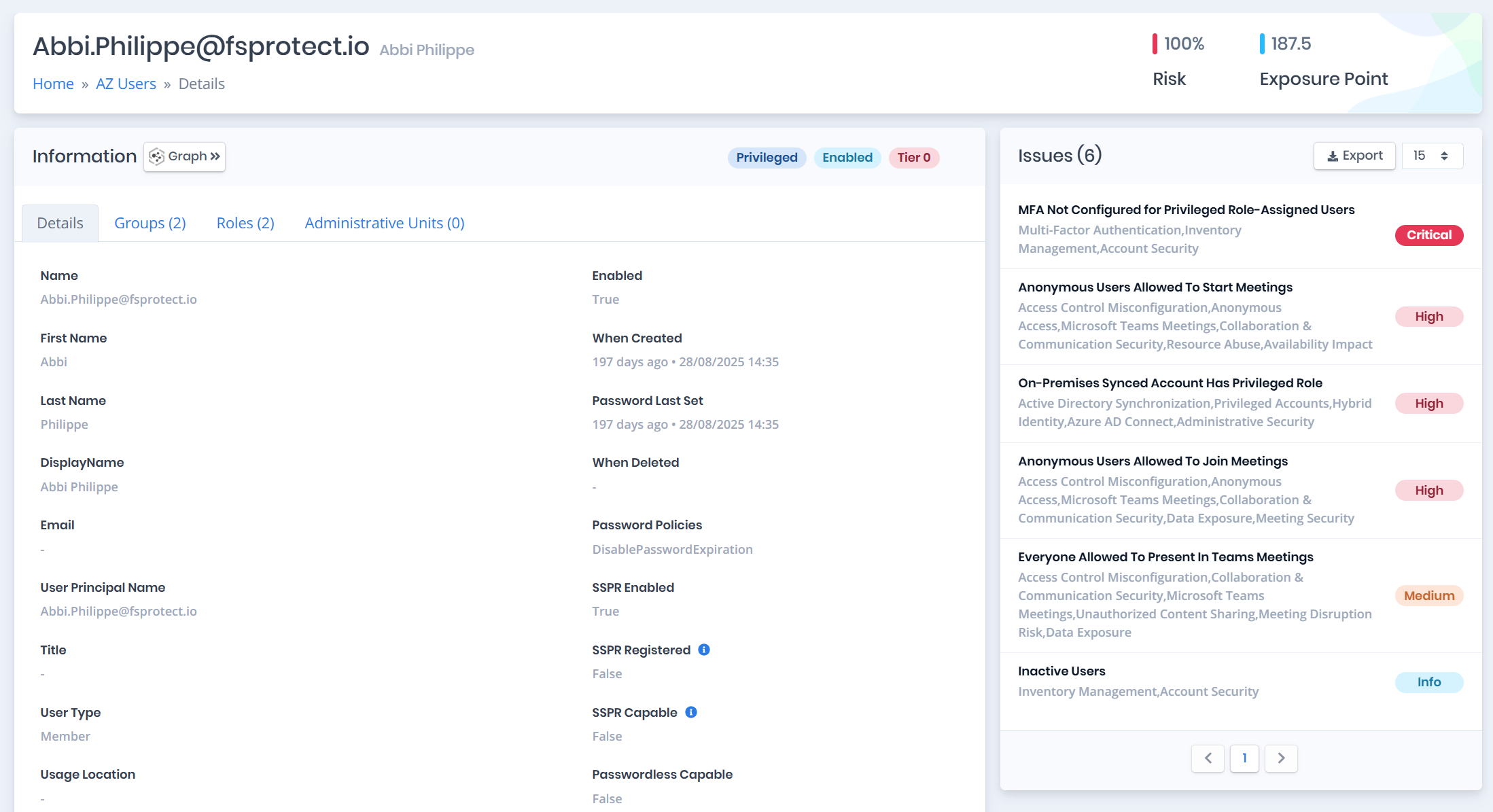
  • Calculate risk and exposure scores for each object to highlight vulnerable identities
Misconfiguration Detection

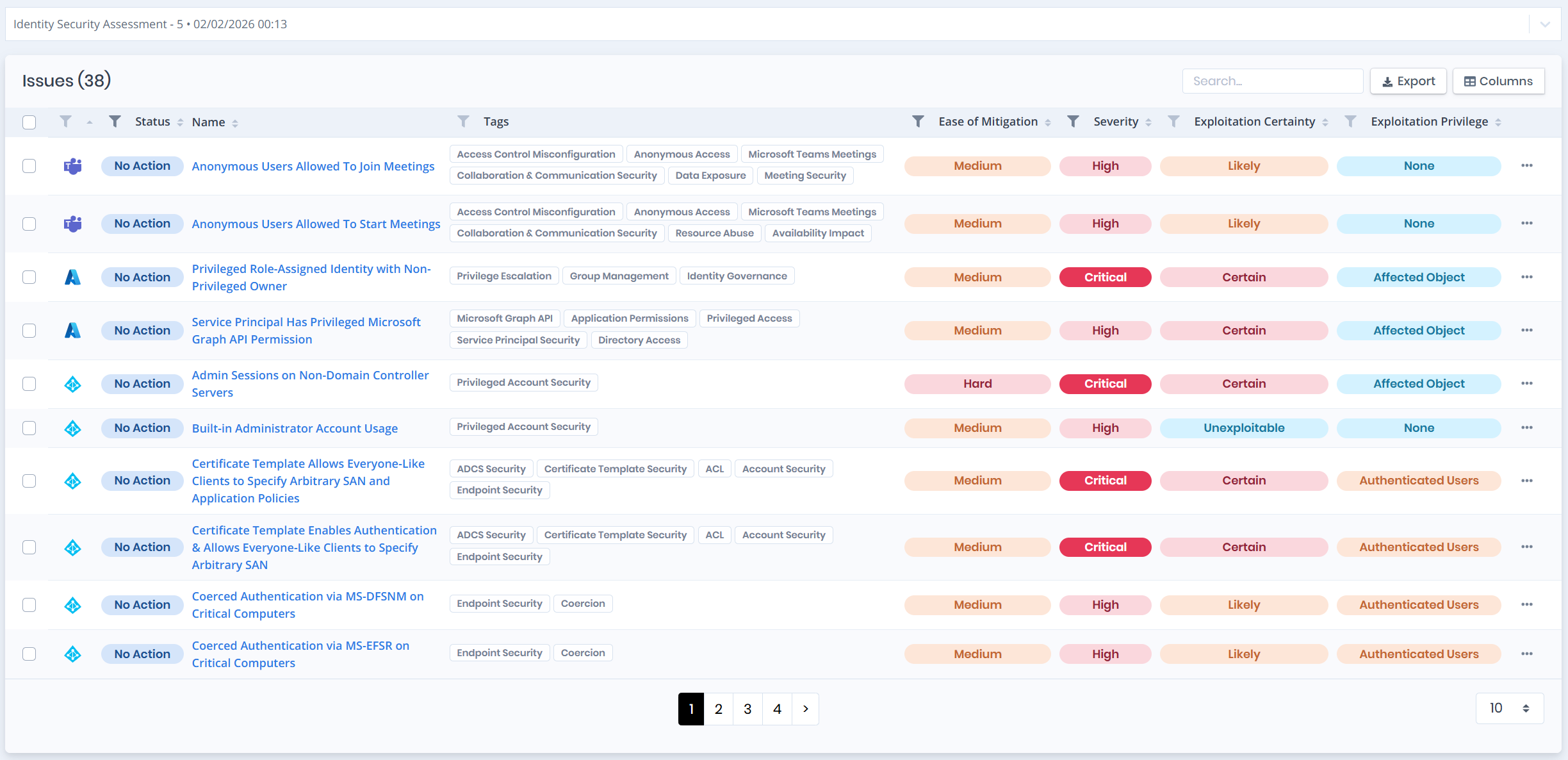
Context-Aware Prioritization

Score every finding against multiple risk dimensions to ensure teams focus on the highest-impact exposures first.

  • Deliver prioritization metrics: exploitation certainty, required privilege, and ease of mitigation
  • Map findings to the MITRE ATT&CK Matrix for standardized scoring and context
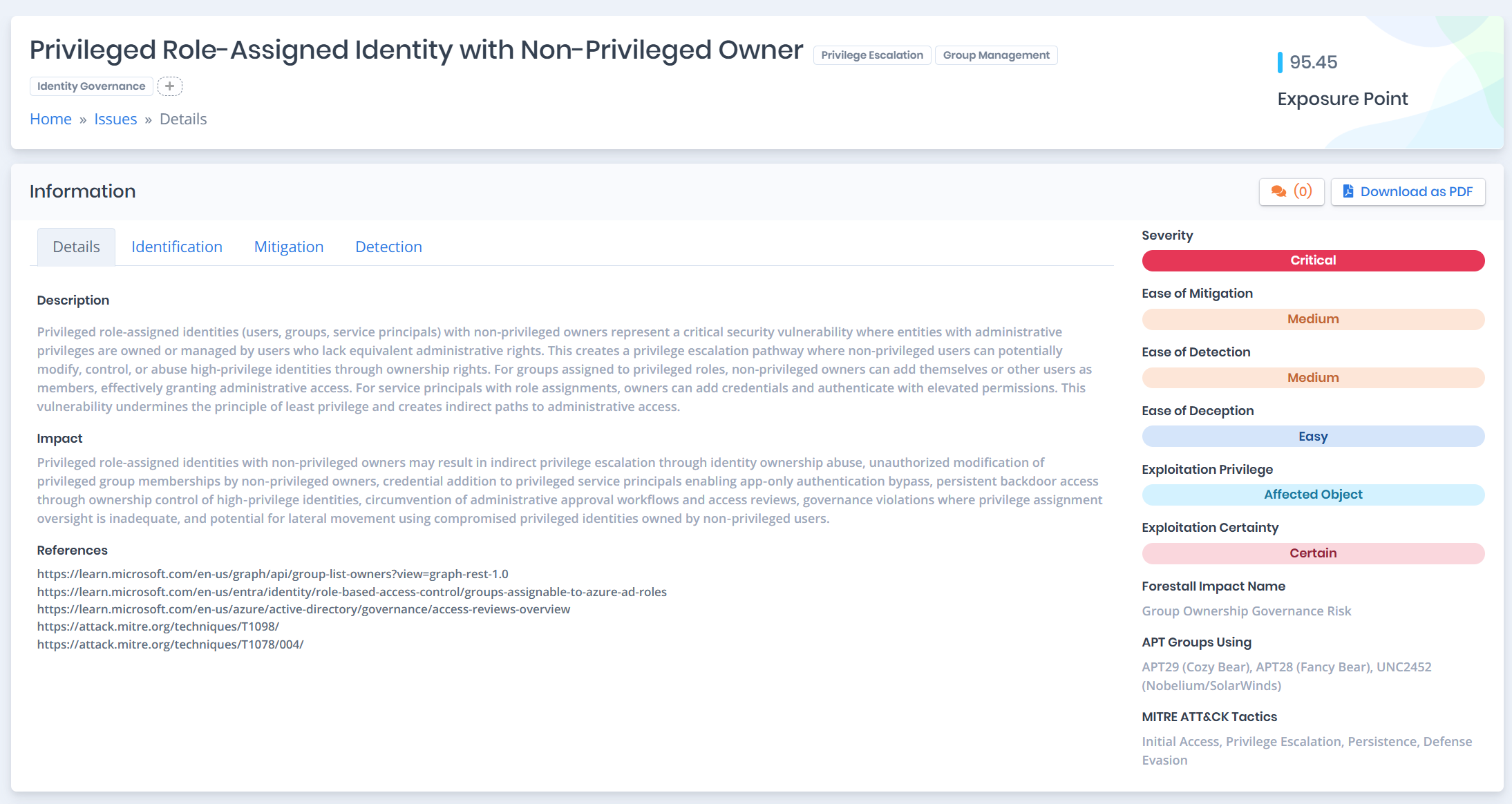
  • Provide actionable guidance for identification, mitigation, and detection
Context-Aware Prioritization

Vulnerability Lifecycle Management

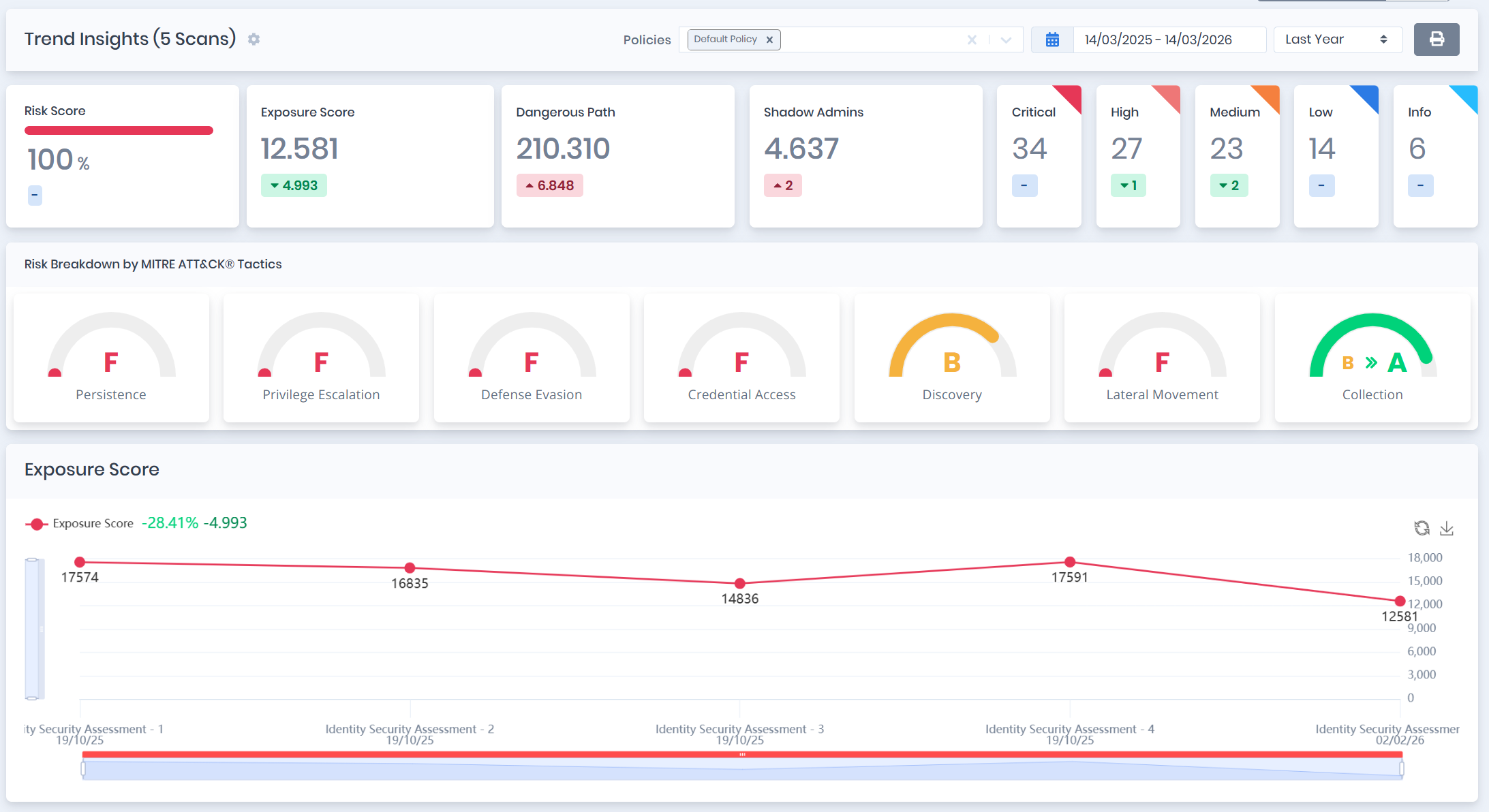
Track findings from discovery through remediation with status management, tagging, and trend analysis.

  • Support in-house vulnerability lifecycle management with status tracking and custom tagging
  • Provide trend insights to track progress and support reporting
  • Enable teams to manage remediation workflows within the platform
Vulnerability Lifecycle Management

Risk & Exposure Scoring

Calculate per-object risk scores that combine configuration state, privilege context, and relationship risk into a single prioritization metric.

  • Calculate risk and exposure scores for each identity object
  • Highlight vulnerable identities based on composite risk factors
  • Provide trend data showing risk score changes over time
Risk & Exposure Scoring

Real-World Use Cases

Triaging Identity Misconfigurations at Scale

Scenario: A security team inherits an Active Directory environment with thousands of objects and no documentation on which misconfigurations are critical versus cosmetic.

How Forestall helps:

  • Detect all misconfigurations across protocols, objects, services, and settings
  • Score each finding with exploitation certainty and required privilege metrics
  • Generate prioritized remediation queues ordered by impact
  • Provide specific remediation guidance for each finding
Outcome: The team focuses remediation on the top 5% of findings that represent 80% of the exploitable risk, instead of working through an unsorted list.
Red Team Findings Validation

Scenario: After a red team engagement, the security team needs to validate which findings represent ongoing risk and which have been mitigated.

How Forestall helps:

  • Cross-reference red team findings with current identity risk scores
  • Map each finding to MITRE ATT&CK techniques for standardized comparison
  • Show which exposures remain active versus remediated
  • Track remediation status with custom tags and status assignments
Outcome: Security teams close the loop on red team findings with evidence-backed validation instead of manual re-testing.

Compliance-Driven Risk Reduction

Scenario: A compliance officer needs to demonstrate that identity risks are being identified, prioritized, and remediated according to regulatory requirements.

How Forestall helps:

  • Provide documented evidence of risk identification and scoring methodology
  • Generate trend reports showing risk reduction over time
  • Track remediation status with audit-ready lifecycle management
  • Export findings by severity, status, and remediation timeline
Outcome: Compliance teams produce audit-ready evidence showing systematic risk identification, prioritization, and remediation—not just point-in-time snapshots.

SOC Identity Risk Enrichment

Scenario: SOC analysts need identity risk context when investigating alerts to understand whether a compromised account represents a high-risk exposure.

How Forestall helps:

  • Provide per-object risk and exposure scores for every identity
  • Show privilege tier, access relationships, and misconfiguration context
  • Highlight whether the object is a Shadow Admin or has excessive privileges
  • Surface related findings that compound the risk of the investigated object
Outcome: SOC analysts make faster, better-informed triage decisions by seeing identity risk context alongside detection alerts.

Frequently Asked Questions

How does Forestall prioritize identity risks?

Each finding is scored against multiple risk dimensions: exploitation certainty, required privilege level, ease of mitigation, and exposure context. Findings are then mapped to the MITRE ATT&CK framework for standardized severity, producing prioritized remediation queues rather than flat alert lists.

What types of misconfigurations does the assessment detect?

The assessment covers misconfigurations across protocols (Kerberos, LDAP, NTLM), identity objects (users, groups, computers), services (Exchange, DNS, ADCS, WSUS, SCCM), and security settings (delegation, trust, GPO configurations).

Can teams track remediation progress within the platform?

Yes. The platform supports full vulnerability lifecycle management with status tracking, custom tagging, and trend analysis. Teams can assign findings, mark remediation status, and generate progress reports over time.

How does MITRE ATT&CK mapping help?

ATT&CK mapping provides a common language for communicating identity risks across security, IT, and leadership teams. It enables standardized severity scoring and helps teams correlate identity findings with broader threat intelligence and detection strategies.

Stop Chasing Every Alert

Focus your identity remediation on the exposures that actually matter. Deploy Forestall and get prioritized risk assessment with actionable guidance for every finding.

We respect your privacy

We use cookies to keep this site secure and working properly. With your permission, we also use optional cookies to understand usage and improve the experience. Cookie Policy

You can change your choice at any time.

Identity Risk Assessment | Solutions | Forestall